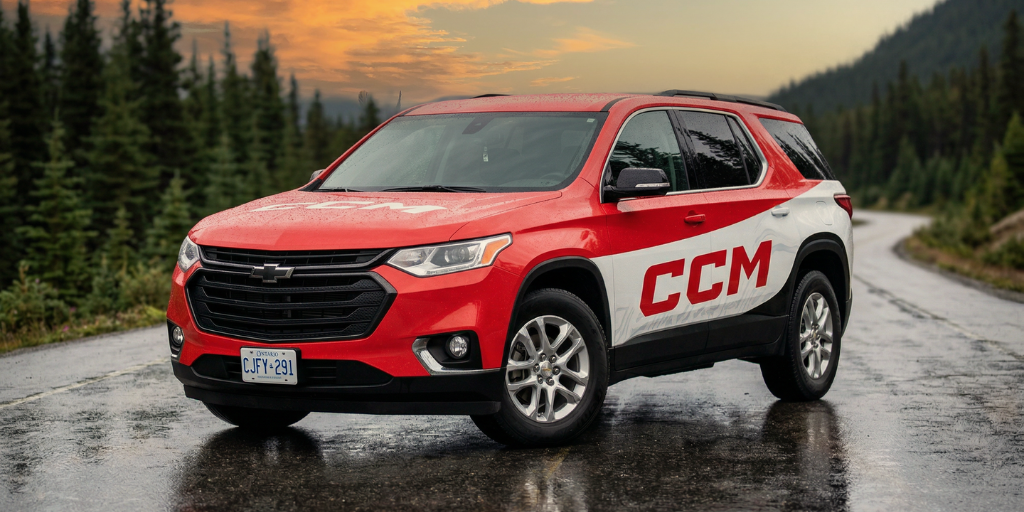
Every vehicle that leaves your lot is moving through your market, passing thousands of potential customers. There's no question about whether your fleet is working. But is it generating leads, or is it just getting from Point A to Point B?
Many business leaders see their vehicles as an operational necessity, but there are many creative ways to give your vehicles another job without extra effort on your part or your team's.
According to the Outdoor Advertising Association of America, a branded vehicle generates roughly 30,000–70,000 impressions per day. That's a lot of eyeballs being exposed to your business and how you can make their life better.
What Vehicle Wraps Actually Do
A vehicle wrap is a mobile billboard that works 24/7, reaching tens of thousands of people daily. Vehicle wraps deliver high visibility at a very low cost per impression, but like all advertising channels, lead generation and sales depend on messaging, targeting, and execution.
Now, you could just slap your logo, phone number, and a QR code to your website onto your vehicle's back window. Or, you could design strategically to capture leads.
Effective vehicle wraps follow a specific framework. They include a clear value proposition, a memorable visual identity, and a direct call-to-action.
Without these elements, your vehicle is just passing by people without converting any of that attention into leads.
The Three Elements of Lead-Generating Vehicle Wraps
Effective vehicle wraps operate on three design principles. Understanding each principle helps you maximize your fleet's lead generation potential.
Element One: Visual Clarity
Your wrap must communicate instantly. A driver passing your vehicle has 3-5 seconds to read and remember your message. This means you can't afford to have clutter or competing messages. You need one clear statement about what you do and why someone should care.
The most effective wraps use high-contrast colours, bold typography, and minimal text—all in service of answering one question: "What does this business do?" Everything else is a distraction.
Clear, simple visual messages increase brand recall, and for your vehicle wrap, this clarity translates directly into your ability to generate leads.
Element Two: Compelling Value Proposition
Your wrap should answer the customer's core question: "Why should I care?"
This isn't the time to list your services. You need to name the problem you solve and the solution you deliver.
For example, instead of "Johnson Plumbing," a more effective wrap might say "Leaks Fixed Same Day, Guaranteed." Instead of "Elite Renovations," it might say "Transform Your Space in 7 Days or Less."
The value proposition is what stops the mental scrolling. It's what makes someone think, "I need to remember this business."
Element Three: Clear Call-to-Action
Your wrap must tell people exactly what to do next. Visit your website. Call this number. Text this keyword. Without a clear next step, attention won't convert into leads.
The most effective CTAs are specific and easy to remember. A phone number is better than a website URL. A short text code is better than a phone number with an extension. The goal is to make the next step so simple that a driver can act on it without writing anything down.
Why Vehicle Wraps Outperform Digital Advertising
Digital advertising is effective, but it's also expensive and increasingly competitive. Vehicle wraps offer a different advantage: they're always on, always visible, and they don't compete with algorithm changes or ad fatigue.
Consider the cost comparison. A professional vehicle wrap costs $2,500-$5,000 per vehicle and lasts 3-5 years. For a 3-vehicle fleet, that's $7,500-$15,000 for 3-5 years of lead generation.
Digital advertising, by contrast, can cost roughly $1,000-$3,000 per month for effective, high-visibility campaigns. That's anywhere from $12,000-$36,000 per year.
The biggest difference is that vehicle wraps generate leads passively. Your team isn't managing campaigns. They're not adjusting bids. They're not monitoring performance. The wrap works while your team focuses on delivering service.
This is why systems-driven businesses use vehicle wraps as part of an integrated visibility strategy. They're not replacing digital advertising. They're complementing it with a channel that works 24/7 without ongoing management.
How SpeedPro Niagara Optimizes Vehicle Wraps for Lead Generation
At SpeedPro Niagara, we design vehicle wraps specifically for lead generation. We start with your target market, your core value proposition, and your lead generation goals. Then, we design a wrap that communicates clearly, compels attention, and drives action.
This includes strategic colour selection (based on your market and industry), typography that's readable at highway speeds, and a call-to-action that's specific and easy to remember.
We also ensure your wrap aligns with your broader brand system. Your vehicles should reinforce your brand identity, not contradict it. When your wraps, signage, and digital presence all tell the same story, lead generation accelerates.
One Action You Can Take This Week
Audit your current fleet. If you have vehicles, take photos of each one.
Ask yourself: Would someone passing this vehicle know what you do? Would they remember your business? Would they know how to contact you?
If the answer to any of these questions is "no", your fleet isn't optimized for lead generation. That's an opportunity.
.svg)

.png?width=1024&height=512&name=How%20to%20Use%20Your%20Vehicle%20to%20Generate%20Leads%20for%20Your%20Business%20(1).png)
.svg)